NOTES
1. ALGORITHM PRINCIPLES
Convolution is a fundamental operation in signal processing that combines two signals to produce a third. Mathematically, it is defined as:
Where \(x(t)\) is the input signal, \(h(t)\) is the kernel (impulse response), and \(y(t)\) is the output. In the discrete domain:
The kernel \(h\) is flipped (time-reversed) and then slid across the signal \(x\). At each shift position, the overlapping values are multiplied and summed.
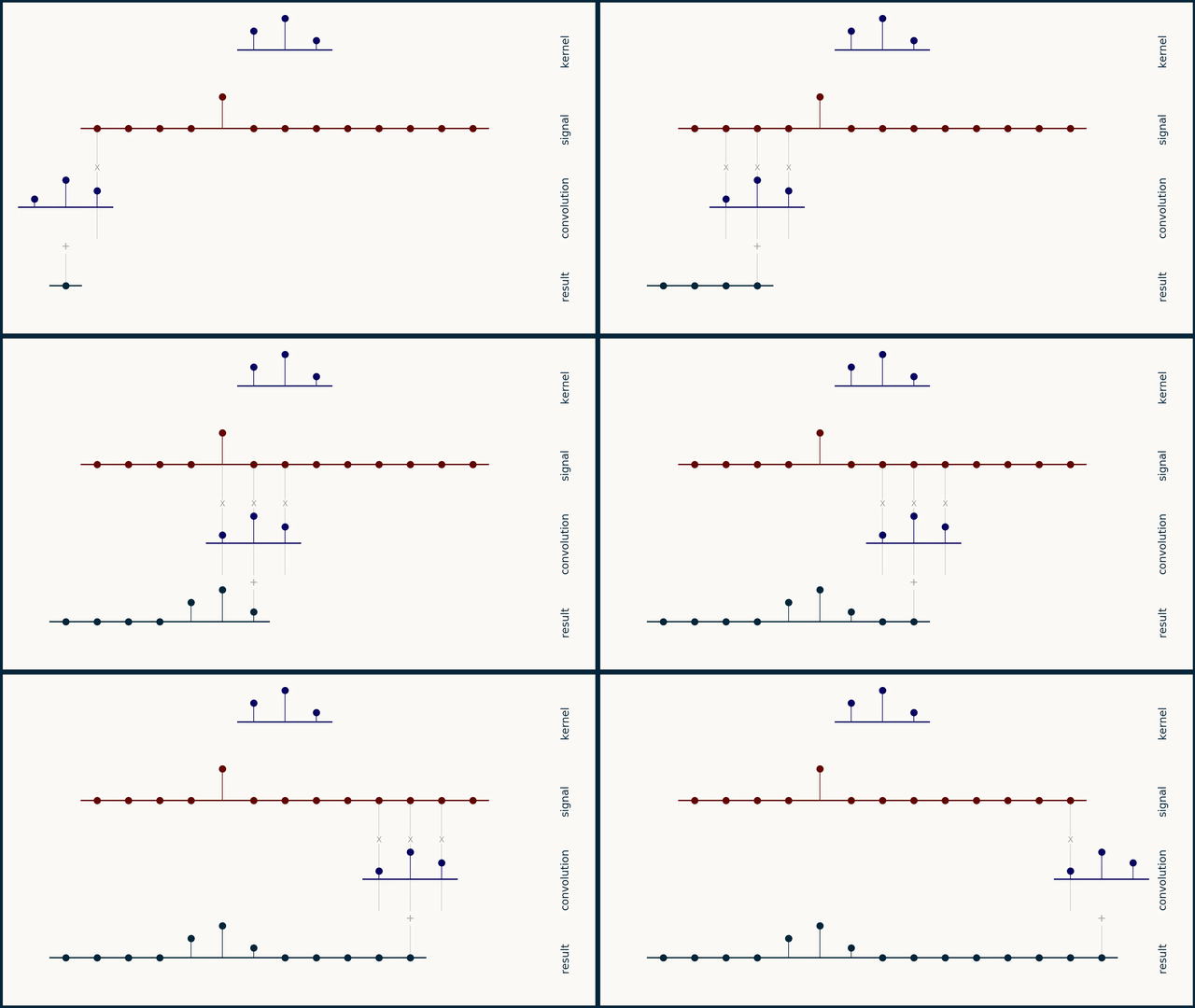
-
Physical Meaning of Convolution (Chinese)
1.1 Full Convolution (default output)
The full convolution between a signal of length \(L_s\) and a kernel of length \(L_k\) produces \(L_s + L_k - 1\) output points. The computation naturally proceeds in three stages:
- Stage I (ramp-up): the kernel is only partially overlapping the left edge of the signal.
- Stage II (steady-state): the kernel is fully inside the signal.
- Stage III (ramp-down): the kernel slides past the right edge.
1.2 Padding Modes
When the kernel extends beyond the signal boundaries, padding provides synthetic samples:
| Mode | Behaviour |
|---|---|
Zero (TINY_PADDING_ZERO) | Missing samples are treated as 0.0 |
Symmetric (TINY_PADDING_SYMMETRIC) | Signal is mirrored at the edge |
Periodic (TINY_PADDING_PERIODIC) | Signal wraps around (circular) |
1.3 Output Modes
| Mode | Output Length | Description |
|---|---|---|
Full (TINY_CONV_FULL) | siglen + kernlen - 1 | Complete convolution result |
Head (TINY_CONV_HEAD) | kernlen | First kernlen points |
Center (TINY_CONV_CENTER) | siglen | Centered portion matching signal length |
Tail (TINY_CONV_TAIL) | kernlen | Last kernlen points |
2. CODE DESIGN PHILOSOPHY
2.1 Dual-Path Architecture (ESP32 vs Generic)
This is the only convolution module that uses platform-specific acceleration. On ESP32, dsps_conv_f32 from the ESP-DSP library provides hardware-optimized convolution. The generic fallback uses a pure-C three-stage implementation that handles arbitrary signal/kernel ordering.
2.2 Three-Stage Generic Convolution
The generic convolution is structured as three explicit loops (Stage I/II/III). This form:
- Is slightly more readable than a single-loop with min/max clamping.
- Allows each stage to be optimized independently by the compiler.
- Correctly handles both
siglen >= kernlenandsiglen < kernlen(the C standard doesn't restrict relative sizes).
Important platform asymmetry: The ESP32 ESP-DSP backend requires siglen >= kernlen and returns TINY_ERR_DSP_INVALID_PARAM if this precondition is violated. The generic fallback has no such restriction.
2.3 const Correctness
Both signal and kernel pointers are treated as read-only (const float *) in the generic path. This prevents accidental modification and allows the compiler to perform better alias analysis.
2.4 memmove for Result Slicing
tiny_conv_ex_f32 selects a sub-slice of the full convolution output by shifting data to the front of the output buffer. It uses memmove rather than a for loop or memcpy because the source and destination ranges may overlap (e.g., in Center mode where start_idx > 0).
2.5 Dynamic Allocation in Extended Mode
tiny_conv_ex_f32 allocates a padded temporary buffer via calloc. This is necessary because padding adds 2 * (kernlen - 1) extra samples. The buffer is freed before return. For real-time or memory-constrained applications, use tiny_conv_f32 which performs no dynamic allocation.
3. API INTERFACE — METHODS
3.1 tiny_conv_f32
/**
 * @name: tiny_conv_f32
 * @brief Convolution function (full mode, zero padding implicit)
 *
 * @param Signal The input signal array
 * @param siglen The length of the input signal array (> 0)
 * @param Kernel The input kernel array
 * @param kernlen The length of the input kernel array (> 0)
 * @param convout The output array for the convolution result.
 *                Caller MUST provide at least (siglen + kernlen - 1) elements.
 *
 * @note On ESP32 the underlying ESP-DSP routine additionally requires
 *       siglen >= kernlen; the generic fallback handles both orderings.
 *
 * @return tiny_error_t
 */
tiny_error_t tiny_conv_f32(const float *Signal, const int siglen,
                            const float *Kernel, const int kernlen,
                            float *convout)
{
    if (NULL == Signal || NULL == Kernel || NULL == convout)
        return TINY_ERR_DSP_NULL_POINTER;

    if (siglen <= 0 || kernlen <= 0)
        return TINY_ERR_DSP_INVALID_PARAM;

#if MCU_PLATFORM_SELECTED == MCU_PLATFORM_ESP32
    /* ESP-DSP requires siglen >= kernlen */
    if (siglen < kernlen)
        return TINY_ERR_DSP_INVALID_PARAM;
    dsps_conv_f32(Signal, siglen, Kernel, kernlen, convout);
#else
    const float *sig  = Signal;
    const float *kern = Kernel;
    int lsig  = siglen;
    int lkern = kernlen;

    // Stage I — ramp-up (kernel partially overlapping left edge)
    for (int n = 0; n < lkern; n++)
    {
        convout[n] = 0;
        for (int k = 0; k <= n; k++)
            convout[n] += sig[k] * kern[n - k];
    }

    // Stage II — steady-state (kernel fully inside signal)
    for (int n = lkern; n < lsig; n++)
    {
        convout[n] = 0;
        int kmin = n - lkern + 1;
        int kmax = n;
        for (int k = kmin; k <= kmax; k++)
            convout[n] += sig[k] * kern[n - k];
    }

    // Stage III — ramp-down (kernel sliding past right edge)
    for (int n = lsig; n < lsig + lkern - 1; n++)
    {
        convout[n] = 0;
        int kmin = n - lkern + 1;
        int kmax = lsig - 1;
        for (int k = kmin; k <= kmax; k++)
            convout[n] += sig[k] * kern[n - k];
    }
#endif

    return TINY_OK;
}
Description:
Computes the full convolution between an input signal and a kernel. On ESP32, delegates to the hardware-accelerated dsps_conv_f32. On all other platforms, uses a three-stage pure-C implementation.
Features:
- Zero-copy: no dynamic memory allocation.
- Platform-accelerated on ESP32.
- Generic fallback supports arbitrary signal/kernel length ordering.
Parameters:
| Parameter | Type | Description |
|---|---|---|
Signal | const float* | Pointer to the input signal array |
siglen | int | Length of the input signal (> 0) |
Kernel | const float* | Pointer to the kernel array |
kernlen | int | Length of the kernel (> 0) |
convout | float* | Output buffer for convolution result. Must hold at least siglen + kernlen - 1 elements |
Return Value:
| Code | Meaning |
|---|---|
TINY_OK | Convolution succeeded |
TINY_ERR_DSP_NULL_POINTER | Signal, Kernel, or convout is null |
TINY_ERR_DSP_INVALID_PARAM | siglen ≤ 0, kernlen ≤ 0, or (ESP32 only) siglen < kernlen |
3.2 tiny_conv_ex_f32
/**
 * @name: tiny_conv_ex_f32
 * @brief Extended convolution function with padding and mode options
 *
 * @param Signal The input signal array
 * @param siglen The length of the input signal array (> 0)
 * @param Kernel The input kernel array
 * @param kernlen The length of the input kernel array (> 0)
 * @param convout The output buffer for the convolution result.
 *                Must hold at least (siglen + kernlen - 1) elements
 * @param padding_mode Padding mode (zero, symmetric, periodic)
 * @param conv_mode Convolution mode (full, head, center, tail)
 *
 * @return tiny_error_t
 */
tiny_error_t tiny_conv_ex_f32(const float *Signal, const int siglen,
                              const float *Kernel, const int kernlen,
                              float *convout,
                              tiny_padding_mode_t padding_mode,
                              tiny_conv_mode_t conv_mode)
{
    if (NULL == Signal || NULL == Kernel || NULL == convout)
        return TINY_ERR_DSP_NULL_POINTER;

    if (siglen <= 0 || kernlen <= 0)
        return TINY_ERR_DSP_INVALID_PARAM;

#if MCU_PLATFORM_SELECTED == MCU_PLATFORM_ESP32
    /* Fast path: delegate to hardware only when all three conditions hold */
    if (padding_mode == TINY_PADDING_ZERO &&
        conv_mode == TINY_CONV_FULL &&
        siglen >= kernlen)
    {
        dsps_conv_f32(Signal, siglen, Kernel, kernlen, convout);
        return TINY_OK;
    }
#endif

    int pad_len = kernlen - 1;
    int padded_len = siglen + 2 * pad_len;
    float *padded_signal = (float *)calloc(padded_len, sizeof(float));
    if (padded_signal == NULL)
        return TINY_ERR_DSP_MEMORY_ALLOC;

    switch (padding_mode)
    {
    case TINY_PADDING_ZERO:
        memcpy(padded_signal + pad_len, Signal, sizeof(float) * siglen);
        break;
    case TINY_PADDING_SYMMETRIC:
        for (int i = 0; i < pad_len; i++)
        {
            padded_signal[pad_len - 1 - i] = Signal[i];
            padded_signal[pad_len + siglen + i] = Signal[siglen - 1 - i];
        }
        memcpy(padded_signal + pad_len, Signal, sizeof(float) * siglen);
        break;
    case TINY_PADDING_PERIODIC:
        for (int i = 0; i < pad_len; i++)
        {
            padded_signal[pad_len - 1 - i] = Signal[(siglen - pad_len + i) % siglen];
            padded_signal[pad_len + siglen + i] = Signal[i % siglen];
        }
        memcpy(padded_signal + pad_len, Signal, sizeof(float) * siglen);
        break;
    default:
        free(padded_signal);
        return TINY_ERR_DSP_INVALID_PARAM;
    }

    // Full convolution on padded signal
    int convlen_full = siglen + kernlen - 1;
    for (int n = 0; n < convlen_full; n++)
    {
        float sum = 0.0f;
        for (int k = 0; k < kernlen; k++)
            sum += padded_signal[n + k] * Kernel[kernlen - 1 - k];
        convout[n] = sum;
    }

    free(padded_signal);

    if (conv_mode == TINY_CONV_FULL)
        return TINY_OK;

    int start_idx = 0;
    int out_len = 0;
    switch (conv_mode)
    {
    case TINY_CONV_HEAD:   start_idx = 0;               out_len = kernlen; break;
    case TINY_CONV_CENTER: start_idx = (kernlen-1)/2;   out_len = siglen;  break;
    case TINY_CONV_TAIL:   start_idx = siglen - 1;      out_len = kernlen; break;
    default: return TINY_ERR_DSP_INVALID_MODE;
    }

    /* memmove: source and destination may overlap in-place */
    if (start_idx > 0 && out_len > 0)
        memmove(convout, convout + start_idx, sizeof(float) * (size_t)out_len);

    return TINY_OK;
}
Description:
Computes convolution with explicit control over padding strategy and output slice selection. The full convolution is always computed first on a padded version of the signal; the requested output mode is then extracted via in-place memmove.
Features:
- Three padding modes: zero, symmetric, periodic.
- Four output modes: full, head, center, tail.
- ESP32 fast path only when all three conditions are met (zero + full + siglen >= kernlen).
- Uses
memmovefor safe overlapping slice extraction.
Parameters:
| Parameter | Type | Description |
|---|---|---|
Signal | const float* | Pointer to the input signal array |
siglen | int | Length of the input signal (> 0) |
Kernel | const float* | Pointer to the kernel array |
kernlen | int | Length of the kernel (> 0) |
convout | float* | Output buffer. Must hold at least siglen + kernlen - 1 elements regardless of conv_mode |
padding_mode | tiny_padding_mode_t | Padding strategy: TINY_PADDING_ZERO, TINY_PADDING_SYMMETRIC, or TINY_PADDING_PERIODIC |
conv_mode | tiny_conv_mode_t | Output slice: TINY_CONV_FULL, TINY_CONV_HEAD, TINY_CONV_CENTER, or TINY_CONV_TAIL |
Return Value:
| Code | Meaning |
|---|---|
TINY_OK | Convolution succeeded |
TINY_ERR_DSP_NULL_POINTER | Signal, Kernel, or convout is null |
TINY_ERR_DSP_INVALID_PARAM | siglen ≤ 0 or kernlen ≤ 0 |
TINY_ERR_DSP_MEMORY_ALLOC | calloc for padded signal failed |
TINY_ERR_DSP_INVALID_MODE | Unknown conv_mode value |
4. FUNCTION COMPARISON
| Feature | tiny_conv_f32 | tiny_conv_ex_f32 |
|---|---|---|
| Padding Mode | Zero padding only (implicit) | Zero, symmetric, or periodic (explicit) |
| Output Mode | Full convolution only | Full, head, center, or tail |
| Output Length | siglen + kernlen - 1 | Configurable based on conv_mode |
| Memory Allocation | None (zero-copy) | calloc for padded buffer (2 × pad_len + siglen floats) |
| ESP32 Fast Path | Always (if siglen >= kernlen) | Only when zero + full + siglen >= kernlen |
| Signal/Kernel Order | Generic path: any; ESP32: siglen >= kernlen | Generic path: any; ESP32 fast path: siglen >= kernlen |
| Boundary Handling | Zero-padding implicit in 3-stage loops | Explicit padding (zero/symmetric/periodic) |
| Use When | Simple full convolution, real-time, no allocation | Custom padding or output slice needed |
When to Use tiny_conv_f32
- You need a simple full convolution result.
- Zero padding at boundaries is acceptable.
- You want maximum performance (ESP32 hardware acceleration).
- You want to avoid dynamic memory allocation entirely.
- Real-time or interrupt-context processing.
When to Use tiny_conv_ex_f32
- You need symmetric or periodic padding to reduce boundary artifacts.
- You want to extract only a specific slice (head/center/tail) of the result.
- You need output length equal to input signal length (center mode) without manual slicing.
- You are processing signals where boundary handling matters (image filtering, circular convolution, periodic signals).
- You can tolerate a one-time
calloc/freeper call.
5. ⚠️ IMPORTANT NOTES
5.1 Output Buffer Minimum Size
Regardless of conv_mode, the output buffer for both functions must be sized for the full convolution:
In tiny_conv_ex_f32, the full result is written first and then the requested slice is shifted to the front. A buffer smaller than siglen + kernlen - 1 will cause a heap buffer overflow.
5.2 ESP32 Signal/Kernel Length Ordering
On ESP32, dsps_conv_f32 requires siglen >= kernlen. If this precondition is violated:
tiny_conv_f32returnsTINY_ERR_DSP_INVALID_PARAM.tiny_conv_ex_f32falls through to the generic path (which handles any ordering).
Recommendation: always ensure siglen >= kernlen for portable code.
5.3 Dynamic Allocation in Extended Mode
tiny_conv_ex_f32 calls calloc internally. If the allocation fails: - Returns TINY_ERR_DSP_MEMORY_ALLOC. - The output buffer is untouched.
In memory-constrained or real-time systems, prefer tiny_conv_f32 or pre-allocate the padded buffer externally.
5.4 memmove vs memcpy
The slice extraction in tiny_conv_ex_f32 uses memmove (not memcpy) because the source and destination ranges overlap. For example, in Center mode, bytes at convout[start_idx] are copied to convout[0], and these regions overlap when start_idx < out_len.
5.5 Padding Modes and Signal Length
- Symmetric and periodic padding both read
Signal[0]andSignal[siglen-1]for mirror/wrap operations. Ifsiglen == 1, the left and right padding edges reference the same single sample. - Periodic mode uses
% siglen— division by zero ifsiglen == 0, but this is caught by thesiglen <= 0parameter check.
5.6 Convolution is NOT Correlation
Convolution flips the kernel; correlation does not. If you need correlation, use tiny_corr_f32 or tiny_ccorr_f32 from the CORRELATION module — do not simply reverse the kernel manually, as the internal implementations differ in boundary handling.