TinyAI · Train · Trainer — Design notes
Notes
Trainer ties together a Sequential model, an Optimizer, a loss type and a Dataset into a standard training pipeline, exposing fit / evaluate_loss / evaluate_accuracy. It lazily collects model parameters and initialises the optimiser on the first call, so application code only needs to describe "network + optimiser + loss" before training starts.
Trainer — The Training Loop: Repeat forward → loss → backward → update
Encapsulates the classic training loop.
Intuition
One Epoch
``` for each batch: 1. forward: model(batch) → prediction 2. loss: loss_fn(prediction, label) → loss value 3. backward: gradient backprop → each param gets gradient 4. step: optimizer updates all params ```
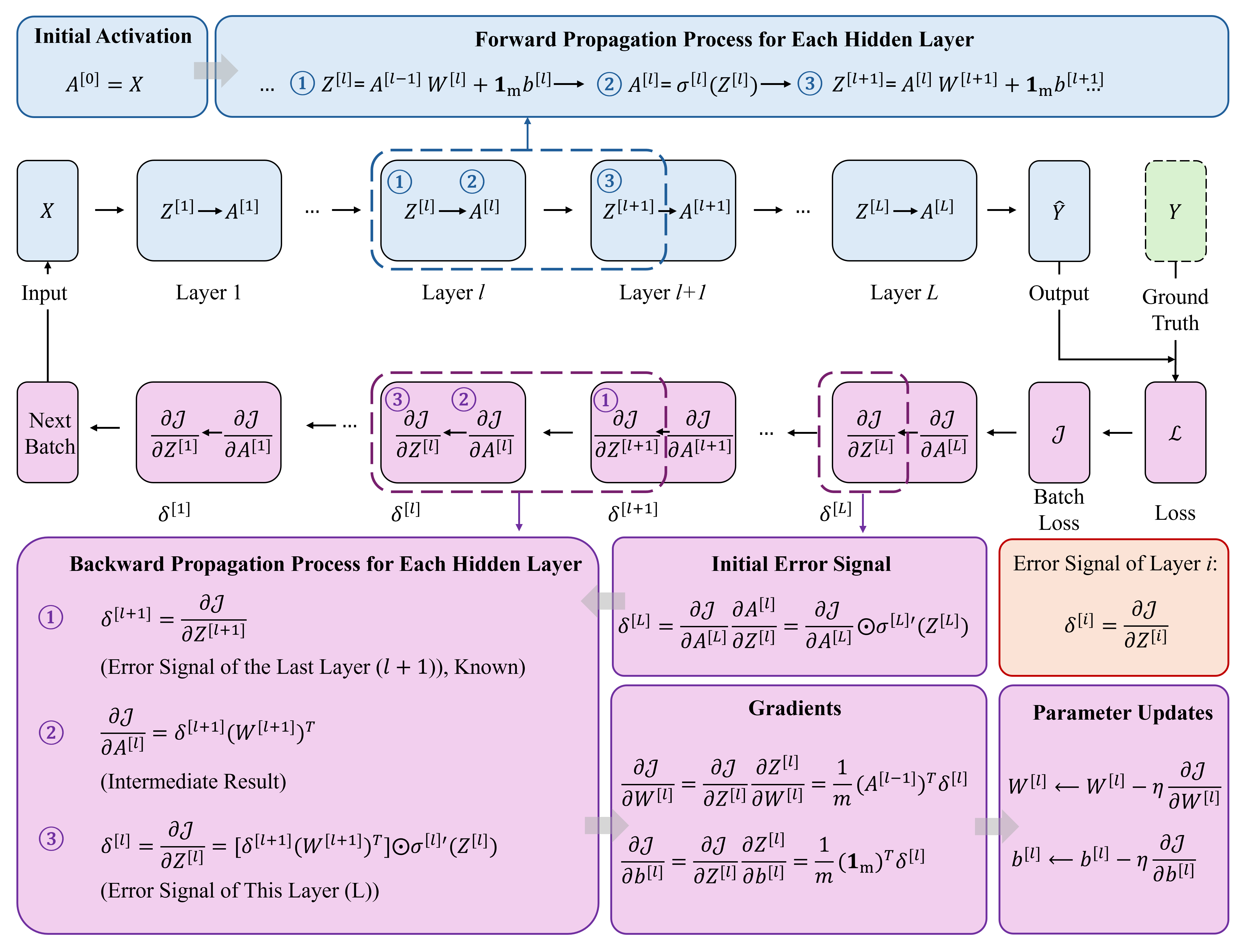
Core API
```cpp Trainer trainer(&model, &optimizer); trainer.fit(&dataset, 100, 16); // 100 epochs, batch=16 ```
Monitoring
- Loss trending down → good
- Loss oscillating → LR too high or batch too small
- Train acc high, val acc low → overfitting
CLASS DEFINITION
class Trainer
{
public:
    struct Config
    {
        int  epochs      = 100;
        int  batch_size  = 16;
        bool verbose     = true;
        int  print_every = 10;
    };

    Trainer(Sequential *model, Optimizer *optimizer,
            LossType loss_type = LossType::CROSS_ENTROPY);

    void fit(Dataset &train_data, const Config &cfg = Config{},
             Dataset *val_data = nullptr);

    float evaluate_loss    (Dataset &data, int batch_size = 16);
    float evaluate_accuracy(Dataset &data, int batch_size = 16);

private:
    void ensure_params_collected();

    Sequential *model_;
    Optimizer  *optimizer_;
    LossType    loss_type_;

    std::vector<ParamGroup> params_;
    bool                    params_collected_;
};
Trainer holds raw pointers — the model / optimiser lifetime is the caller's concern.
fit FLOW
void Trainer::fit(Dataset &train_data, const Config &cfg, Dataset *val_data)
{
    ensure_params_collected();   // first-time optimiser init

    int *y_batch = TINY_AI_MALLOC(...);

    for (int epoch = 0; epoch < cfg.epochs; epoch++)
    {
        train_data.shuffle(epoch + 1);
        ...
        while (next_batch returns > 0)
        {
            Tensor logits = model_->forward(X_batch);
            float  loss   = loss_forward(logits, ..., loss_type_, y_batch);

            optimizer_->zero_grad(params_);
            Tensor grad = loss_backward(logits, ..., loss_type_, y_batch);
            model_->backward(grad);
            optimizer_->step(params_);
        }

        if (val_data) print "Epoch  loss=  val_acc="
        else          print "Epoch  loss="
    }
}
Highlights:
- Each epoch triggers
train_data.shuffle(epoch + 1)to avoid the "same order" training bias. - The loss is dispatchable across
MSE / MAE / CROSS_ENTROPY / BINARY_CE. For classification,Tensor target = zeros_like(logits)is just a placeholder; the real labels come fromy_batch. cfg.print_everycontrols log cadence: everyprint_everyepochs the loss is printed (and val accuracy whenval_datais passed).
evaluate_loss / evaluate_accuracy
float evaluate_loss(Dataset &data, int batch_size = 16);
float evaluate_accuracy(Dataset &data, int batch_size = 16);
- Both call
data.reset()and run forward in batches; they never mutate model parameters. evaluate_lossreturns the average loss across batches.evaluate_accuracyreusesSequential::predictto argmax, comparing against the realy_batchto return accuracy.
USAGE EXAMPLE
using namespace tiny;

Dataset full(X, y, N, F, C);
Dataset train, test;
full.split(0.2f, train, test, 42);

MLP model({F, 16, 8, C}, ActType::RELU);
Adam opt(1e-3f);
Trainer trainer(&model, &opt, LossType::CROSS_ENTROPY);

Trainer::Config cfg;
cfg.epochs      = 100;
cfg.batch_size  = 16;
cfg.print_every = 10;

trainer.fit(train, cfg, &test);
printf("Final test acc = %.4f\n", trainer.evaluate_accuracy(test));
TRAINING SWITCH
- When
TINY_AI_TRAINING_ENABLED == 0, the entireTrainerclass (fit / evaluate_*included) is removed by the preprocessor, leaving only inference APIs. - For ESP32-S3 deployments you can disable training at
idf.py menuconfigtime to save ROM and RAM.
CUSTOM TRAINING LOOP
If the default fit is not enough (LR scheduler, mixed precision, custom logging…), follow the pattern in example_attention.cpp: hand-roll forward / backward / step while still leveraging Dataset and Optimizer:
std::vector<ParamGroup> params;
model.collect_params(params);
opt.init(params);
for (...)
{
    int actual = ds.next_batch(X_batch, y_batch, batch_size);
    Tensor logits = model.forward(X_batch);
    Tensor dlog   = cross_entropy_backward(logits, y_batch);
    opt.zero_grad(params);
    model.backward(dlog);
    opt.step(params);
}